• Essays, Products 19.01.2012 2 Comments

    I recently signed up for the financial website Mint to see how it compared to our existing financial organization (a fancy Google Spreadsheet). Though Mint came highly recommended, it doesn’t compare favorably.

    Mint does a good job of aggregating account information in one place, so I can now see on a single screen our credit card charges, banking transactions, investments, mortgage balance, and home equity (using the current estimate for our property’s market value from Zillow). This gives an excellent picture of our net worth at a glance, which is fun to see.

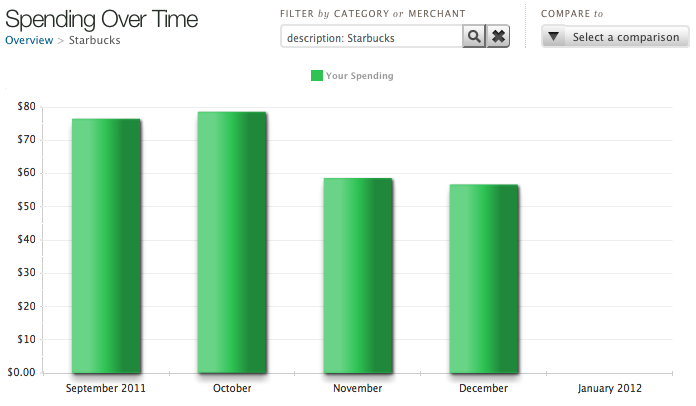
    Mint's "Spending Over Time" Graph

    Mint's "Spending Over Time" Graph

    The site then categorizes expenses and graphs your spending on coffee (for example) over time. This is imperfect but it’s easy enough to correct errors.

    But the point of any financial tool isn’t to analyze past spending but to budget future spending. Mint’s offering there is fairly weak. The entire model is built around categories so you can budget your coffee consumption or groceries for the month.

    That’s not a bad idea, but it overlooks several major aspects of how people spend money. I’ll outline five of them.

    First, our real budget accounts for several fixed once-monthly expenses like Netflix. That’s clearly an “Entertainment” expense, but it’s not really an optional expense from month to month. Unless we cancel the service, Netflix will charge us exactly $7.99 at some point in January, which means we have $7.99 less to spend than our paychecks say. The same is true for phone service, cable television, and other monthly activities. In Mint, though, you can’t track particular bills; you can only track categories. It might report that you’ve got $30 left for entertainment, but does that include Netflix? Or do you really only have $22.01 left?

    Second, we account for some variable once-monthly expenses like our electric bill. I don’t know the amount for January’s bill but I know we’ll get one. This means our budget may set aside $200 for electricity but when the bill arrives we pay only $100 then we instantly have an extra $100 to spend on something else. In Mint, if your utilities budget is $200 and you’ve spent only half of it, the other half is still ready to go. There is no concept of being “done” with an expense.

    Third, Mint does allow some control for unusual or one-time expenses in that you can set a budget for a certain category in only one month, but the reasoning is opaque. In my spreadsheet I may add a line for “Dentist Appointment” but in Mint I must instead increase the budget in my “Health & Fitness” category by that amount. If the appointment moves I have to decrease this month’s amount and increase next month’s.

    Finally, Mint’s budgets are generally confined to a single month; there’s no clear picture of the annual budget. We pay our car insurance premium in full in January and July, which means we overspend dramatically those months. January’s budget alone makes us appear to be living well beyond our means. But a complete annual budget shows that we more than make up the difference in the other ten months and in fact save nearly $200 on our premium in the end.

    The area where Mint works well is for ongoing expenses like groceries and entertainment. As long as your spending categories align with your budget categories, the budgeting tool works well. What you can’t do is budget entertainment and clothing as a lump sum while still tracking spending in each category separately.

    I update our budget spreadsheet every day with our most recent expenses. The task is the worst part of a spreadsheet budget and it’s what Mint does best. For Mint to be useful as a financial tool, the budgeting needs to improve.

    I’d like to see a focus on (and organization around) expenses: the kind you know in advance and the kind you don’t. Categories are great for analysis, but they shouldn’t be so critical in budgeting future spending. And there needs to be a better “big picture” view of an entire year (or more).

    Mint is already immensely powerful and it’s completely free. As several people have pointed out to me, for someone who doesn’t already have a household budget, Mint would be an excellent place to start. And maybe after a while you too can setup a Google Spreadsheet!

  • Essays 07.01.2012 No Comments

    As Sophie gets older we’re naturally expecting her to do more chores. She already cleans her own room and now also makes her own bed, does homework every night, and helps out around the house with tasks appropriate for her age. We’ve started seeing “Job Chart” or “Chore Chart” systems to help organize and reward these responsibilities, and so far they’re shockingly harmful ideas.

    My Job Chart is the ultimate example, using high technology to solve the problem. Parents assign tasks via a website and award points for each task completed successfully. Children can then redeem those points through the website for parent-approved Amazon purchases, in-home treats, or family activities. This is a particularly advanced approach, but is structurally similar to what’s been done on paper for years: list the chores to be completed and list the rewards available for a job well done.

    The entire idea (whether on paper or online) is fundamentally flawed.

    First, individually rewarding specific behaviors encourages children to seek a reward for every behavior. Why help put away the Christmas decorations if the job doesn’t pay well enough? Plus, if each chore carries a reward, they all seem optional (“I don’t want a new toy this week so I won’t clean my room.”)

    Second, much good behavior that deserves a reward doesn’t belong on a checklist. I recently saw a child Sophie’s age throw himself to the sidewalk screaming that he couldn’t get dinner from his favorite restaurant. I’m glad my daughter doesn’t behave that way (and told her so), but I would never have put “don’t throw a tantrum” on a checklist.

    Finally, material rewards are… well, materialistic. Many systems encourage using “family rewards” instead — “spend time with Dad” and “read a bedtime story together” are popular suggestions — but that idea should be downright horrifying. We’re suggesting bedtime stories are conditional? If the child doesn’t finish her homework she doesn’t get time with Dad? ”Sorry, honey; I can’t love you today. But if you clean your room tomorrow I’ll be able to love you for 30 whole minutes!” Worst of all, if both monetary and non-monetary rewards are available, the child can put a price on priceless activities. When twenty “points” buys either a $5 toy or a fun day with Dad, could she also buy an extra Dad day with $5 of her allowance? Would I have to charge extra for hugs?

    These limitations do not translate to adulthood. We get rewards constantly (paychecks not least among them) but never with an itemized receipt for our behaviors. If I fail to vacuum the living room my wife will not automatically refuse to put away the dishes. If I do only the tasks assigned to me at work and never offer my own ideas I will be passed up for promotions and may even lose my job to a more “motivated” employee. Why would we create an artificial environment for our children that teaches them skills they can’t use as they mature?

    Adults’ responsibilities are mandatory. We suffer consequences (e.g., unemployment or spousal fights) when we disregard them. Moreover, though, we expect the rewards we get. I did not earn the privilege of my wife cooking dinner yesterday, or any particular dollar of my paycheck last month.

    We should offer the same expectations to our children for their own responsibilities. Sophie must clean her room; if she doesn’t, we’ll dispose of the mess. If she doesn’t eat a healthy dinner her supply of treats will run dry in a hurry. But bedtime stories are an every night event, and she gets “time with Dad” whenever either of us asks for it (not to mention “time with Mom” which doesn’t even make the cut for recommended Chore Chart rewards).

    Let’s do our kids a favor and eliminate “Chore Charts” from the world.

  • Essays 19.06.2011 No Comments

    The economics of school portraits are entirely nonsensical.

    When I was a student I’d bring home a sample portrait (stamped “SAMPLE” to ruin its usability) and an order form for procuring prints in various sizes. Now what comes home is a complete portrait package with five sheets of fully finished prints. Parents send back any they don’t want along with payment for the ones they’ve kept and an order form for any more they still need.

    So parents already have the product in hand and are just paying to keep it. And since there’s no resale value for a specific child’s prints, parents are really paying to not destroy the prints they already have.

    Most of the apparent illogic here is surely the result of phenomenal economies of scale. Once the photographer is on site and has setup all his equipment, taking one more child’s picture adds almost no expense. Once the expensive photo printers are up and running, printing five more sheets is similarly inexpensive. The possibility that having all those pictures of their children in hand will incentivize some parents to pay justifies the small up-front expense.

    What’s less easy to explain is this: I own a scanner. So when a beautiful, glossy 8×10 photograph comes home in my daughter’s backpack, I am not motivated to pay for it. I’m motivated to scan it in high resolution, and then return it for free.

    That would probably violate either an implicit contract with the photographer or copyright law, but the very nature of the product makes its duplication impossible to police. I’m never going to be caught selling illegal copies of my daughter’s school picture on eBay, for example. Virtually the entire worldwide market for this particular item lives in my house.

    Is this business model founded on trust in parents not to just make copies? Or on an assumption nobody’s smart enough to try it? Or are there just so many new parents buying prints now that losing a few to scanning technology is justifiable?

    Whatever the reason, I’m not sure I want to discourage the practice. It looks like I may be able to get twelve years of free portraits out of it.

  • Essays 18.06.2011 1 Comment

    I’ve found myself with little need for a cell phone now that I’m working from home — I just use it for occasional solo errand runs and as security against freak roadside emergencies. So I’ve switched to Boost Mobile’s “pay as you go” plan.

    The plan is designed for this situation. There’s no monthly fee or contract; I just bought the phone outright (paying all of $30 for a basic “makes calls, sends texts” phone) and I pay 10¢ a minute any time I make or take a call.

    Here’s what’s not in their marketing: credit on your account expires in just 90 days. The actual policy reads:

    Note: You must add money to your account at least once every 90 days.If not, any unused credits in your Boost™ Prepaid Account Balance will expire and your account will go to zero, but don’t worry because your account will be automatically recharged with Auto Re-Boost.

    “Don’t worry” — it’s okay that we’ll throw away your money if you haven’t paid us in a while, ’cause then we’ll immediately come take more money automatically! Since the smallest automated payment they’ll take is $15, that’s a guaranteed minimum expense of $5 / month, even if the phone was turned off the entire time.

    That’s called a monthly fee. Let’s not kid ourselves.

    Yes, I could turn off “Auto Re-Boost” (their automatic payment plan), but that doesn’t stop credit from expiring; it only stops it getting replenished automatically. I’d still have to pay them every three months, but with the added risk that I might forget and render my phone unusable. On the other hand, manual payments can go as low as $10, making the monthly cost a lower $3.33.

    I’ve had the phone for three weeks now, and in that time I’ve rung up $1.90 in calls, with 90¢ of that on initial setup (e.g., validating Google Voice and trying to disable voicemail).

    (For the record, the “pay as you go” plan does not support conditional call forwarding, but you can disable voicemail entirely. You just have to call Boost until you get someone who knows what you’re talking about.)

    It’s a lot better than $50 / month, but we’ve got a long way to go before this is quite the service it’s made out to be.

  • Anecdotes, Essays 19.02.2011 1 Comment

    Wedding planning involves shopping for a lot of big items — a venue, a caterer, a professional photographer, and myriad other services. All are unique in their offerings, but almost every vendor we’ve encountered has shared a fundamental assumption about weddings: the groom is just dead weight.

    One venue toured us through the luxurious bridal suite with four-poster bed and adjoining private bathroom, and then through the groom’s room with some chairs and a poker table. At our actual venue the bride is promised chilled champagne and a plate of fruit, while the groom should expect a twelve-pack of domestic beer. (It’s the “domestic” that really sells it.)

    Conclusion: I will be so bored at my own wedding I’ll want to bring a deck of cards and get drunk with my friends while my bride carries out the celebration on her own.

    At dress shops (catering legitimately only to women) brides-to-be can bring their friends to solicit advice as they try on sample gowns and evaluate the elegance of various designs. At Men’s Wearhouse, I was handed a book with ten glossy photographs of models in tuxedos and asked to point to one like a kid ordering off a children’s menu. The clerk took measurements and ushered me out the door, without so much as a peek at a physical tuxedo. (We canceled our order there and went to Al’s Formalwear where we were able to see real products and choose the best style shirt, tie, vest, jacket, and pants — and even try on a sample tuxedo. And with the total $70 less, the moral is: never go to Men’s Wearhouse.)

    One department store recently invited us to a “Sip & Scan” party in order to create a wedding registry. They’d be serving drinks and hors d’oeuvres, and promised consultants in each department to help us choose the items we’d most like to guilt our friends and family into buying for us. And in each e-mail urging us to come, the bride is reminded to “bring your fiancé (he’ll love the scan gun).” I won’t care what dishes we have or what color our sheets are, as long as I can scan some barcodes!

    With the gender stereotypes this overpowering, the wedding industry should be enthusiastically supporting same-sex marriages everywhere. While male couples would unfortunately never set foot in a wedding venue, female couples would be free to spend billions of dollars on their weddings without the restrictive dead weight of a groom.

  • Halloween has always been a great testament to the flexibility of our capitalist economy.

    A Halloween Superstore took over a massive (previously abandoned) retail space at our town’s shopping mall this year — an anchor location that might once have been a Sears or a JCPenney. They converted half the space into an enormous stock room and the other half into display areas for packaged costumes, masks, wigs, makeup, accessories (like “Toto in a Basket” to accompany the quintessential Dorothy costume), and elaborate holiday decorations (like bloodied hands you can place strategically under your garage door to frighten unsuspecting children).

    Of course, at dawn on November 1st, the entire operation became a liability. The remaining inventory was immediately reduced to 50% its original prices and sold off to people planning for next year. The store closed a couple days later.

    The extra candy stockpiled at grocery stores across the country was also reduced to clearance prices on November 1st, kitschy candy buckets in the shapes of pumpkins and severed heads were thrown away to linger forever in landfills, and trick-or-treaters everywhere stuffed this year’s costumes back into dressers and closets to be forgotten until next year.

    It’s capitalism at its finest. An industry emerges overnight and disappears by the next morning, all for the sake of profiting from a few hours of children’s entertainment.

    But this doesn’t compare in brilliance to the economic transaction a friend of ours offers her children after every Halloween: “I’ll buy as much candy as you’re willing to sell for 5¢ apiece. Then you can use the money to go buy a toy you can keep forever, instead of candy that will be gone after you eat it.”

    The kids get toys to play with and eat less sugar, while the parents get to devour Halloween treats without the guilt of taking candy from their babies.

  • Essays, Sophie 16.10.2010 1 Comment

    Politicians love to defend the Pledge of Allegiance almost as much as they like to oppose burning our nation’s flag. The wholesome, patriotic, downright American tradition of reciting a pledge of loyalty in schools every morning is the sort of thing only an America-hating terrorist would ever oppose.

    Unless, of course, you believe that America stands for theological freedom, and find the phrase “under God” at odds with certain religious beliefs. Or you believe that America stands for political freedom, and find the entire notion of mandating allegiance from citizens a bit… Red.

    I always got hung up on the “under God” bit. I’m on the record of being in favor of liberty and justice for all. Rainbows and puppy dogs aren’t half bad either. But then some clown crammed an “under God” in the middle of the thing (nearly 60 years after the pledge was first coined, mind you), and didn’t even add meaningful content with it. Instead, the extra appositive phrase just makes the whole sentence almost impossible to parse to a child who’s still trying to get the hang of correctly conjugating the word “is” on a regular basis.

    But apart from the atrocious grammatical implications, the phrase implies a certain basic religion: that God presides over our country. Thus anyone who believes in more or fewer Gods than just the one is unable to faithfully pledge their allegiance to the entire country, if following the scripted pledge.

    While this makes for an interesting academic argument (and occasionally affords politicians some good sound bites), and while I still believe it wholeheartedly, it may overlook some important details.

    My daughter, now in kindergarten, was playing quietly in the living room this morning when she spontaneously launched into this recitation:

    I pledge allegiance to the flag of the United States of America, and to the bepuplic for which it stands: one nation, under God, in-invisible, with ligerty and jujace for all.

    So she’s not developing a sense of God watching over us, or of mandatory loyalty to an ineffable and eternal nation. She’s trying to figure out what a bepublic is and what made it invisible.

  • On Tuesday, February 23rd, gunman Bruco Eastwood shot and wounded two students at Deer Creek Middle School in Littleton, Colorado. Math teacher Dr. David Benke was outside patrolling the parking lot after school at the time. When he heard the first shot, he charged at the gunman and wrestled him to the ground.  Teachers Norm Hanne and Becky Brown were close behind.  Bus driver Jim O’Brien shouted at the students already on his bus to get down and make the bus look empty before he rushed out to help hold down the attacker.  Nobody was killed in the attack.

    On Christmas Day last year, Umar Farouk Abdulmutallab brought explosives onto Northwest Airlines flight 253 in his underwear.  Passenger Jasper Schuringa put out the fire, burning his hands in the process, and then dragged the would-be bomber to the front of the plane to be restrained.  Nobody was killed.

    Back in December of 2001, Richard Ried tried to light a fuse leading into the explosives his shoe on American Airlines 63.  Flight attendant Hermis Moutardier caught him in the act, and with the help of flight attendant Cristina Jones and other passengers subdued the 6’4″, 200 pound man, and restrained him with a seat-belt extension, belts, and headphone cords.  Jones remarked to Time magazine afterward:

    Most of it was instinct, and the knowledge of the Sept. 11 attacks. I don’t believe I would have grabbed [Reid] the way I did had I not known about Sept. 11. I don’t know that the passengers would have come to my aid so quickly had they not known about Sept. 11.

    Nobody was killed.

    The attacks of September 11th, 2001, at the cost of of 2,976 lives, may have taught us the most valuable lesson we’ve ever learned: that apathy, complacency, and (above all) inaction can have greater costs than we might ever imagined.  We began that day with fantasies of terrorism where John McClane can rush to the rescue of anyone who sits quietly and stays out of the way.  We ended it understanding that even when resistance is as deadly as it was for the passengers of United flight 93, the consequences of inaction — of not being John McClane, if only for a moment — can be even greater.

    While the Transportation Security Administration learned from Richard Ried that travelers need to remove their shoes before boarding an airplane, the public already knew not to tolerate lit matches on board a flight.  Even while we depend on police protection for our everyday safety, the police cannot be everywhere at every moment.  But Dr. David Benke and his peers can be — collectively — and can be able to act immediately in society’s defense.

    One of the most moving and memorable speeches in Aaron Sorkin’s The West Wing (from 20 Hours in America) comes after a bombing at the fictional Kennison State University.  President Bartlett gives this address:

    Forty-four people were killed a couple hours ago at Kennison State University.  Three swimmers from the men’s team were killed and two others are in critical condition when after having heard the explosion from their practice facility they ran into the fire to help get people out.

    Ran into the fire.

    The streets of heaven are too crowded with angels tonight.  They’re our students and our teachers and our parents and our friends.  The streets of heaven are too crowded with angels.

    But every time we think we’ve measured our capacity to meet a challenge, we look up and we’re reminded that that capacity may well be limitless. This is a time for American heroes.  We will do what is hard.  We will achieve what is great.  This is a time for American heroes and we reach for the stars.

    This is a time for American heroes, and we have them in abundance.

  • Essays 17.05.2009 2 Comments

    In 2004, the Massachusetts Bay Transportation Authority closed four stops on the B Branch of the Green Line, to the approval of almost 73% of riders surveyed.  The stops remain closed today.  Now it’s time to close more.

    Eliminating stops ultimately makes trips faster.  Each stop requires trains to accelerate and decelerate, and more importantly adds hold time at the platform as passengers board and disembark.  On crowded trips, the boarding process alone can take upwards of a minute at every stop even when everyone hurries.

    The goal in any mass transit system must be to separate stops as widely as possible without unnecessarily inconveniencing riders.  The question is what distance is both “far enough” without being “too far.”

    Underground stations on the Green Line between Government Center and Kenmore (where B trains run) are spaced 583 meters apart, on average.*  That’s about the distance diagonally across Boston Common, and about the same density of stops in Manhattan. Of course, passengers will generally walk only half that distance to get to the closest station.

    Above ground, however, between Kenmore and Packard’s Corner, stops are only 306 meters apart, or about the length of a single crosstown block in Manhattan.  Imagine a New York subway train stopping every block!  Some of these need to be eliminated.

    Of the eight stops in question, the shortest trips are from Boston University East to Boston University Central and from Boston University West to St. Paul Street.  The middle segment, from West to Central, is the longest.

    Suppose we keep West and Central as they are, then, and eliminate the adjacent stops, beginning with St. Paul Street, barely a block away.  Babcock Street could also go, putting the three remaining stations 416 and 546 meters apart, respectively.  That’s about the underground average.

    Across the turnpike, Boston University East is also a perfect candidate for removal based on distance, and I support that, but it’s also benefited immensely from the costly beautification work done there just recently, so I don’t have high hopes for its elimination.

    The only valid counterargument I’ve heard to eliminating any of these stops is that the individual platforms are not large enough to support the required number of passengers.  In other words, the reason St. Paul Street and Boston University West are practically touching is so they can act in combination as a larger platform.

    Anecdotally, I’ve never seen such a problem.  The crowds on these platforms are light, even on heavy rush hour trips that are far behind schedule.  During the Boston University Commencement, which surely generates the heaviest travel in the area, crowds would overhwlem any platform, which is why we always see MBTA staff supervising operations (and, at least last year, manually turning the entire platform into a fare-controlled area).

    However, if there’s real evidence against these platforms’ adequacy, there are several solutions.  First, they can easily be lenghtened.  Even if four-car trains will never arrive (as seems likely, since we have yet to see even three-car trains in regular service), a four-car platform is perfectly usable.  Second, and admittedly costlier, sacrificing a few parking spaces would allow ample room to widen the platforms into the street — a small price, even in Boston.

    Most importantly, crowds at every platform will diminish as service speeds up.  Fewer people can gather during a five-minute window between trains than can in a window that’s 15 minutes long.

    We need to eliminate these stops.  Let’s skip over them for six months, and if crowds on any platform truly become unmanageable, we can put them back in just as easily as they came out.  If, instead, there’s no harm and service gets faster, at least 73% of riders will be made happier.

    *I performed all measurements in Google Earth using the “ruler” tool.  For underground stations, I used Google’s placement of the station icon to estimate the platform’s position.

  • Essays 18.01.2009 No Comments

    The MBTA needs to explore a simple, low-cost (perhaps free) solution to one of the Green Line’s  most common and most noticeable problems: trains bunching together.  Dynamic looping, as I’ll call it, lets inbound trains get reassigned easily and transparently to different outbound lines.

    Any regular rider knows that trains tend to come in pairs, and can sometimes emerge from the subway in groups of four or five at a time.  After 30 minutes without any service, a stream of trains will roll by together — the first few packed to capacity, and those behind nearly empty. Although this is a maddening failure to provide transportation, its causes are easy to understand.  Traffic lights turning red, inconsiderate or inattentive drivers stopping on the tracks, pedestrians running in front of trains, and other routine parts of city life all impose delays.

    Every second that a train gets behind schedule allows more passengers to accumulate at upcoming stations.  A larger crowd of passengers takes longer to board, so the train is even more delayed at the next station, and the problem cascades.  Meanwhile, as the following train catches up, even fewer people accumulate at each stop so the later train can quickly find itself tailgating its predecessor with hardly any passengers aboard.

    Many expensive capital projects could improve services.  With limitless funds, burying the B Line up to Packard’s Corner would be a smart move.  More realistically, the T could let trains preempt traffic signals (extending green lights a little longer if a train is about to pass through) as many other cities do.  Even that, however, would require new equipment that the MBTA cannot afford.  We need a free solution that we can implement with the resources already on hand.

    Let’s accept that delays above ground are inevitable but that not all lines will be delayed in the same way at the same time.  Currently, underground stations usually see a fairly steady stream of trains.  Unfortunately, they are not distributed evenly among the four branches. A trio of B trains might pass uselessly by passengers who have been waiting for a D train who then crowd into the next D car when another is right behind it.

    Since we accept that delays are inevitable on the inbound trip, we can assume that B and D trains will tend to arrive at Government Center (their last stop) in pairs spaced closer together than when they left Boston College or Riverside.  Currently, those poorly spaced trains will loop at Government Center and start their outbound trips to the same place they originated, incurring more delays all the time.  By Washington Street on the B and C lines, all hope is lost, and trains are frequently sent “express” to the end of the line.

    By introducing dynamic looping, delays can be corrected or even eliminated halfway through the trip.

    When a train arrives at Government Center, it should begin outbound service on whichever branch needs it most.  If the last B train left 10 minutes ago and a D train left just 3 minutes ago, the next train should make Boston College its destination.  Later, when a pair of delayed B trains arrives together, one can service the Riverside branch.  By routinely reassigning trains in this manner, delays are either balanced across multiple branches, or in some cases eliminated entirely.

    Until recently, Type 8 cars couldn’t run on the Riverside branch, so Boston College and Riverside trains were not interchangeable.  However, since at least December, Type 8 cars have been in regular revenue service on both branches.  Now is the perfect time to implement this simple and affordable system.

    No passengers would even need to be aware of this new policy.  Both branches begin their service at Government Center, so people waiting on the platform would not have any prior expectation about which train might appear next.

    Unfortunately, this is not true for the C and E lines.  Their inbound trains run to North Station and Lechmere respectively.  Even excluding them, dynamic looping can improve service on two lines.  However, with a more dramatic change, we could expand the program to all four branches.

    First, all trains could be reassigned when entering Government Center.  Some B and D trains might continue north (as though coming from Heath Street or Cleveland Circle), whereas some C and E trains might discharge their passengers and loop.  This would add complexity that dispatchers would need to unravel, and would confuse (and presumably annoy) many passengers.

    Alternatively, all trains might terminate at Government Center.  This would simplify the dispatcher’s job to that of tracking which of the four branches most needs the next train.  Service to the north would come from shuttle trains operating on Government Center’s inner loop — a stretch of track already in place for southbound trains to turn around and return north.

    These shuttle trains would be operating entirely on dedicated rights of way (underground or on overpasses), so their schedules should be inherently more reliable than the trains at street level.  This would lessen another major complaint about the Green Line: that service to North Station is too unpredictable (another symptom of the same basic problem).

    This is a more dramatic step, of course, whose disadvantages shouldn’t be overlooked.  Someone who works on Beacon Street in Brookline and commutes via the Commuter Rail might be pleased at having more regular and reliable service, but might be displeased at suddenly needing to change trains at Government Center.  This is an area that requires further study from past occasions when the T has changed a line’s terminating station.

    Even without the C and E lines, however, a pilot program with just the two branches that already loop at Government Center is worthwhile.  Dynamic looping could make a big difference in performance and passenger satisfaction.  At a time when use of mass transit is rising, but when no funding is available for major capital improvements, this simple solution could go a long way.

    It’s time for a change.