This is one of my all-time favorite things seen on Facebook:
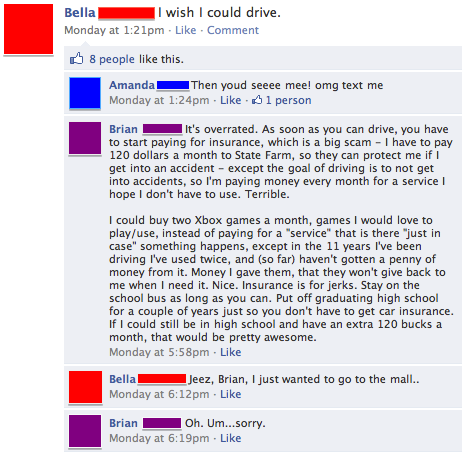
I Wish I Could Drive

This is one of my all-time favorite things seen on Facebook:
I Wish I Could Drive
Using the iOS app WeightBot I’ve tracked my weight every day (with some gaps) since 2008. I started out overweight, and you can see in about May of 2009 I decided to do something about it. I made an effort to control my portion sizes (mostly by saying “no fries” when ordering burgers at UGrill). It worked, a little:

2009
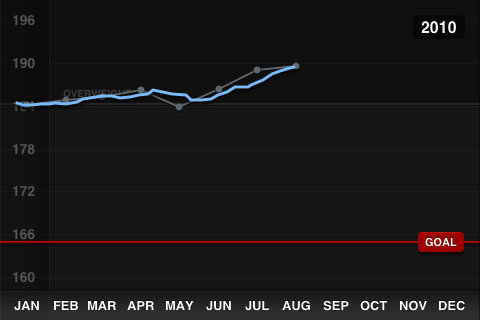
I hovered around the “overweight” line for a few months before shooting back up over the summer of 2010. Oops. I also stopped recording my weight quite so consistently for the rest of the year.
2010
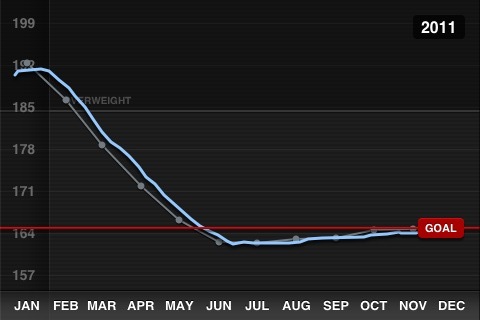
And then… WeightWatchers!
2011
Done! I reached my goal in about four months, and then stayed there for the past two years. I took these screenshots from WeightBot after I reached my initial goal, but then 2012 and 2013 look about the same.
The secret? There isn’t one, really. WeightWatchers just asks you to keep track of what you’re eating and not have too much of it. For us, the trick was making healthier choices all day. We buy 1% milk instead of 2% now. We substituted turkey hot dogs for beef. If we go out for a big meal, we balance that with lighter meals earlier in the day, or additional exercise.
Not every substitution was a success. Sugar-free maple syrup is terrible; I’d rather have the full-calorie kind and then go for a run. Most of the time, though, we were just as happy with the lighter alternative. And by constantly making healthier choices, it’s a habit now. Even a full week in Vegas, eating whatever we wanted whenever we wanted it, we each gained only about 1.5 pounds.
It doesn’t feel very impressive to pickup a bag of low-fat shredded cheese, but it sure looks impressive on a graph!
A company called teehan+max has developed an engine for taking Google Street View images and building video time lapses — basically reconstructing what you might have seen if you were aboard Google’s car, perhaps staring at interesting nearby landmarks. The result is this:
Lowe’s is using this website as the feature graphic for its “Electrical” section. I’ve been staring at it for a while now, and I’m still not sure whether this is a type of tool with which I am not intimately familiar, or the stock photography has gone awry.

Tools are Hard!
Watching “Voice Over”, a short (9 minute) film from Kamel Films, will make you very uncomfortable. Watch it anyway — all the way through.
(via Kottke)
Need to know where to take those “hard to recycle” items? Your new best friend is Earth911.org. Just type what you need to recycle and where you are. You’ll get a list of places you can bring that item, with an impressive amount of detail.
Something simple like “corrugated cardboard” brings up Longmont’s single-stream curbside recycling as the first result. That’s easy. Something trickier like “cell phones” finds a list of nearby stores that will accept them. I brought a pair of old phones to Staples today, and a burned-out compact fluorescent light bulb (the first I’ve ever had burn out) to Lowe’s.
Being able to find a place to recycle everything from packing peanuts to batteries on a single website makes the chore of disposing of recyclable trash more than a little easier.
I think “Les Misérables on a modern airline” is really all I need to say about this. Though I’ll add that it’s absolutely fantastic.
For example, I Dreamed a Dream begins:
I dreamed a dream that I could fly non-stop from Baltimore to Phoenix. And I’d be smiling in the sky, not down here crying in a kleenex. When I was young, flights weren’t delayed. And better in-flight food was tasted. There were no bag fees to be paid. No frequent flyer miles were wasted.
But the fees now come in spades. And you fear you’ll be blacklisted. Airlines tear your hope apart. And they turn your dreams to shame.
I kept a carry-on by my side. They made me check it in as baggage. A hefty fee was then applied! And it was gone at baggage claim.
We surprised Sophie with a trip to Disneyland last summer. At nearly seven years old, we weren’t sure how well she’d balance the childlike magic of so special a place with the adult demands: walking, scary rides, heat, and crowds. The Internet is filled with plenty of suggestions about Disneyland, including many for lowering costs and beating crowds. I have nothing to add to those lists. What I didn’t see anywhere were tips for making the experience magical. Here are the ones we learned this summer:
Watch the Parade
And watch it on the first day. The parade features a stream of recognizable Disney characters backed by powerful music, and fills the parade route with some intense Disney magic. The characters don’t just wave vaguely at the crowd; they make eye contact and acknowledge individual spectators. When Rapunzel looked down from her tower, smiled delightedly at seeing Sophie’s Rapunzel costume, and blew her a kiss, I melted. I can’t even recall the moment without tearing up a little.
There’s a great little viewing area between the Matterhorn and the Castle. It’s the only patch of ground not actually part of the parade route there, so once there you’re trapped for the duration of the parade, but that made the crowd wonderfully thin. And since nobody else can stand nearby, we got a lot of character attention.
Go in Costume
Sophie spent some time in princess costumes and some time in her regular clothes. The difference in the Disneyland experience was like night and day. Children and adults alike showered Princess Sophie with attention. Children tugged on their parents’ sleeves to point out the princess walking among them. Younger children seemed truly convinced they had just met Rapunzel herself. Adults curtsied and addressed her as “Princess” throughout the park.
If there happens to be a new character, that’s best of all. Merida costumes had just come out when we visited. Even cast members accustomed to seeing princesses come through their lines all day marveled at the new dress. Merida got easily twice as much attention as Rapunzel.
For what it’s worth, Tiana seems to have introduced a racial barrier to being a princess. We saw Belles, Auroras, and Cinderellas of all colors and nationalities, but we never saw a single white Tiana anywhere.
Visit Bippity, Boppity, Botique
This beauty salon exclusively for princesses and princes was the icing on top of our first magical day. I hadn’t realized this staple of the Magic Kingdom was also available in Disneyland, so we arrived without reservations but easily made an appointment for the same afternoon. (I don’t know if that would have been possible on a busier day.)
The Fairy Godmother engaged Sophie in conversation the entire time, not only treating her to the most elaborate hair and makeup application she’d ever experienced, but furthering the fantasy of Disneyland. She told of how Rapunzel, upon leaving her tower, had to learn about makeup from the other princesses. How if Sophie had taken a poison apple from the Evil Queen she might have to find and kiss Naveen (Princess Tiana’s frog) in the moat outside the castle. How Ariel often had her father transform her back into a mermaid to go swimming outside her Grotto (in California Adventure).
We paid about $50 for the hair and makeup and then tipped about another $50 to the fairy godmother, who well and truly delivered some Disney magic. More expensive packages include new dresses, professional photos in a carriage, and other accoutrements, but the basic hair and makeup was more than enough. You also get a bag with all the makeup and accessories needed to redo the style the next day.
Skip the Princess Breakfast
Ariel hosts a brunch at her “Grotto” in California Adventure. It’s the only character meal featuring all the princesses together, but it was profoundly bad.
Meeting princesses throughout the park was lovely. The Fairy Godmother conspiratorially warned Sophie against taking any apples from the nearby Evil Queen. Ariel invited Sophie to go swimming with her, if King Triton would agree to give Sophie a mermaid tail — purple, of course. And the Mad Hatter grumpily insulted the uneven lengths of her pigtails, refusing to take a picture with her until he had evened them out.
But in Ariel’s Grotto, the interactions were too hurried, and the characters seemed unhappy to even be there. Four princesses tour the room (Cinderella, Aurora, Snow White, and Belle were there for us), and since everyone’s seated at the same time they make staggered grand entrances. We seated Sophie with the best view of the restaurant, but she still turned constantly in all directions in case anyone was approaching from behind her. She didn’t eat a single bite of breakfast until they all left the room. (We were among the last people in the restaurant — I suspect because many other families just left with hungry children and uneaten food.)
Disney regulars suggest greeting princesses with subtle prompts like, “It’s so lovely to see you again, Princess Cinderella!” or “Jessica has been nervous about meeting you today, your highness, but I’m so honored to make your acquaintance.” This helps the characters interact with your child, but it also enhances the fantasy — you’re happy to meet them too. At Ariel’s Grotto, this was impossible. Cinderella hurried to our table and scooped up Sophie’s autograph book before anyone could even get out a “hello” and very nearly signed it for the second time.
Look for princesses throughout the park. Maybe give a different character breakfast a try. But the Grotto is just a place to get exceptionally expensive scrambled eggs, and leave with children hungry of both belly and spirit.
Buy an Autograph Book
Our first stop upon entering the park was the souvenir shop. Even if you don’t think you’ll need one and your child swears disinterest, buy the book. We chose one with a pouch for a photograph on each page, so we were able to couple each signature with a picture of Sophie meeting that character — and that’s a priceless souvenir. But mostly, having an autograph book takes the awkwardness out of meeting the characters. Even if you have nothing to say, you can ask for an autograph.
Throw Away the Itinerary… At First
The guide books will tell you to tour in a logical sequence. Hit the big attractions first, or focus on one land at a time. That’s great advice, but not appropriate for your first day. The park can be absolutely overwhelming. Sophie couldn’t remotely begin to wrap her mind around the place, so she focused intensely on the most tangible attractions. Can we ride that big riverboat? Absolutely! Tom Sawyer’s island? Let’s go! King Arthur’s Carousel? Done!
After that we insisted on touring more practically (“Of course we can do Star Tours again, but what else would you like to do in Fantasyland first?”), but allowing complete flexibility on that first day gave Sophie the control she needed for the park to be mentally manageable.
Use FASTPASS… Properly
FASTPASS lets you skip the long lines at the most popular attractions. Novices may think you can have only one FASTPASS at a time. That’s not strictly true. You can get another pass as soon as it’s time to use your first one (whether you’ve used it or not) — with a maximum of two hours. So if you pickup a pass at 8:00 that lets you ride at 4:00 pm, you can still get your next pass at 10:00.
You can also hold passes for both parks separately, and World of Color doesn’t count at all. We picked up passes to Star Tours one morning on our way into the park. Then, when Sam took Sophie back to the hotel for a nap after lunch (another tip: everyone will need a nap — especially the adults), I quickly toured both parks, picking up passes to Splash Mountain, World of Color, and Tower of Terror all at once. On our way back into the park we got another Star Tours pass (so we now held five sets), and then rode attractions like crazy for the rest of the day.
Go All Out
Everyone has a budget, but remember that every corner you cut takes a little magic out of the trip. The on-site hotels are more expensive, but they make it easier to go back for a nap during the day. Food in the park is more expensive (though not exorbitant), but it’s easier to grab a quick lunch in between attractions. Snacks and souvenirs can make a dent in your budget too, but nothing says “vacation” as much as the phrase, “Of course you can have an ice cream cone!”
For us, bottled water was an unexpected cost. We planned to refill bottles from water fountains throughout the day like normal people, but we just couldn’t handle the taste. Buying bottles was absolutely worth it. Plus, we could just recycle them when we’d finished, and have fewer things to carry.
Cut whatever corners you have to cut to make the trip work. Just remember that part of what you’re buying is magic, and that may be worth a little extra money. We could probably go back to Disneyland this year on a lower budget, but I’d rather save up and have more flexibility next year.
College Humor imagines what a Dora the Explorer action movie might be like. Tagline:
The “Modern Family” star breaks skulls and language barriers.
Their Dora the Explorer trailer video disallows embedding, so you’ll just have to watch it on YouTube.
As far as I can tell, this great infographic came from an anonymous user on Quora a couple years ago. Here’s the whole of science in 11 tidy panels:

d