• Essays 21.12.2008 1 Comment

    In the era of Google Maps, every business should embed a map to its establishment directly on its website.  It’s easy for any competent web developer to do and it’s free.  Not having such a map is embarrassing.

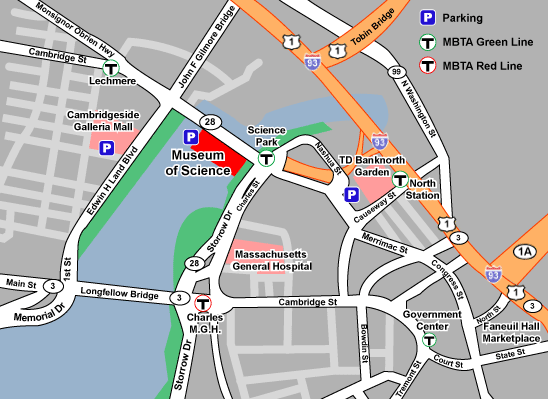
    Antiquated "Museum of Science" Map

    Antiquated "Museum of Science" Map

    Of course, we can sympathize with businesses who simply don’t have the resources to update their websites.  Good web developers are not in infinite supply (and aren’t cheap), so the temptation to “leave well enough alone” is understandable.

    The Museum of Science still uses what I call a “hand-edited” map to highlight its location.  Shown at left, it highlights some basic streets and key points of interest, but shows only the features its creator deemed important.

    Hand-edited maps give a tolerable overview of a location.  Someone familiar with Boston can glance at this and understand where the Museum is.  However, someone new to the area will likely want more information.  Where is it in relation to the hotel?  What other T stops are in the area?  Is this on the way to the airport?  Are there restaurants nearby?

    Large institutions can reasonably answer these questions with an “all singing, all dancing” map.  Boston University Maps incorporates thousands of hours of human effort to catalog campus geography and area attractions, and the Massachusetts Bay Transportation Authority shows the location of every bus stop on every route in the city. These are excellent websites, and we should have more like them, but we also can’t expect the Museum of Science to single-handedly offer such a tool to its visitors.

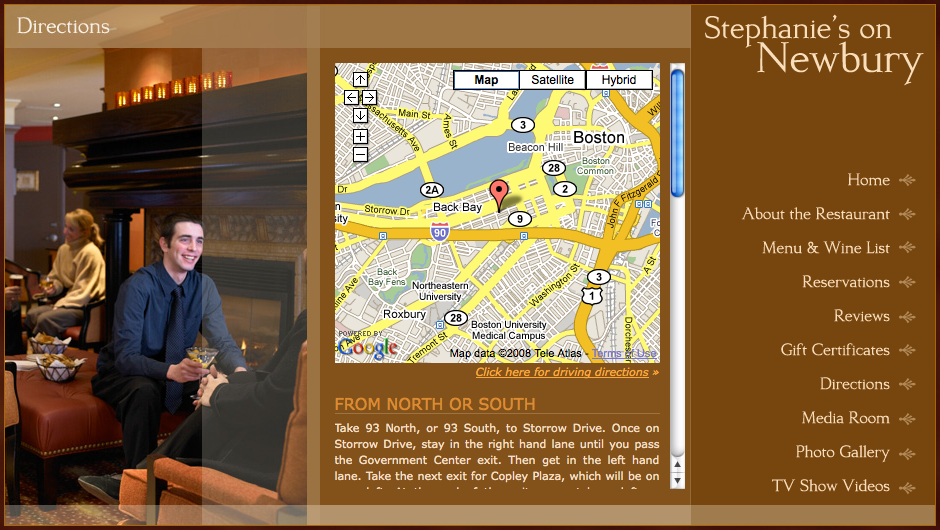
    Stephanies on Newbury

    Stephanie's on Newbury

    Fortunately, a “plain vanilla” Google Map is virtually effortless to install and offers all the context a visitor really needs.  Suppose I’m interested in dining at Stephanie’s on Newbury — a nice restaurant in Boston’s Back Bay neighborhood.  Their directions page offers just such a map.  Building a page like this requires precisely six lines of particularly simple JavaScript, which the creator can copy directly from Google’s own examples (and just change the location).

    This gives roughly the same level of detail as the Museum of Science does at first glance, but then any visitor can use the controls to pan and zoom, customizing the view.  I can see immediately that the restaurant is in the Back Bay, and then zoom in to pinpoint its address on Newbury street.  Someone only passingly familiar with the Back Bay might pan from side to side to find other nearby landmarks, then estimate how far the restaurant is from each.

    For no added cost, Stephanie’s has provided an excellent geographical tool for its potential customers.

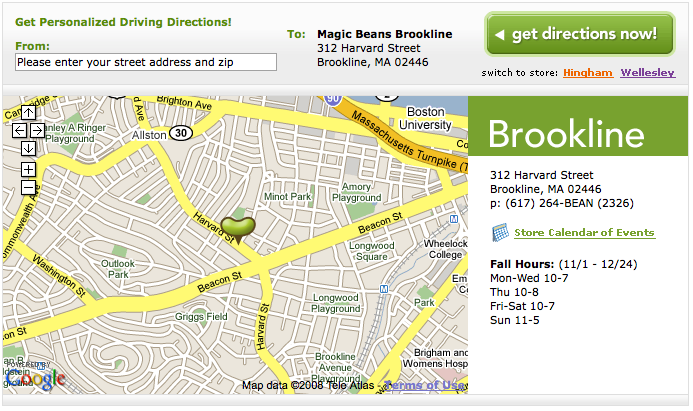
    Magic Beans Map

    Magic Beans

    Many sites prefer to customize the “plain vanilla,” adding their own design elements.  Magic Beans, a toy store in Brookline uses their own “bean” logo instead of Google’s pin, for example.  This improves the site’s overall design while keeping all the functionality.  The map still pans; the map still zooms.

    Some sites — particularly those faced with extremely limited budgets or extremely inexperienced developers — take an acceptable shortcut by linking directly to Google Maps (without embedding a map in their site).  Espresso Royale, a chain of coffee shops, offers such a link for each of their locations. Visitors again get the benefits of an interactive map, and site maintainers do slightly less work.  We’ll still call that a win.

    All these sites, faced with their own unique challenges, have done a good job.  A site that hasn’t had time to update a page is not embarrassing.  A site that’s updated to include a Google Map certainly isn’t embarrassing; it’s desirable.  What’s embarrassing is a site that specifically updates its map page but still avoids making it interactive.

    Moogy’s (a Brighton restaurant), Buttercup Bakeshop (a Manhattan cupcake shop), and the Center for the Performing Arts in Natick each opened Google Maps, took a screenshot, and embedded that on the page.  Doing this takes longer than embedding a map properly, and offers a vastly inferior visitor experience.  Those unfamiliar with the area are again confined to seeing only the landmarks the site designer hand-picked.

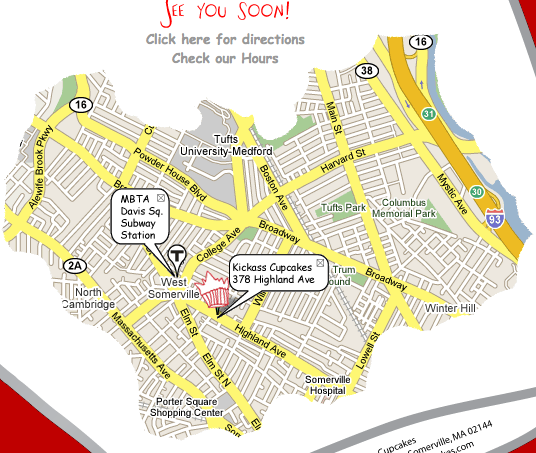
    Artsy Google Map

    Artsy Google Map

    Some sites, staggeringly, go a step farther and give their screenshot an artsy treatment.  The Bowery Poetry Club is one example, embedding a soft, faded copy of a Google Map in the lower right corner of the page.

    There’s also a great cupcake place in Davis Square that took a snapshot and then cropped it in an irregular shape.  This particular site even has its own custom “popups” on the map for the restaurant and the Davis T stop.

    Design is important on a website, but let’s not get carried away.  That puts form before function.  The map design won’t likely win over any customers, and it might drive away a few who can’t figure out where the business really is.

    Put a stop to the madness.  Put a map on every site, and make it a fully functional interactive version.  It’s easy, it’s cheap, and it’s immeasurably useful to those planning even the simplest of outings.

    (For the record, I’ll happily offer an hour of my time — gratis — to any of the sites mentioned that wants a proper Google Map.)

  • Essays 06.12.2008 No Comments

    The Green Line rolling stock (that means “trains”) includes two different types of car:

    1. The Type 7 car, manufactured by the Japanese firm Kinki-Sharyo starting in 1986
    2. The Type 8 car, manufactured by the Italian firm Ansaldobreda starting in 1999

    The newer cars, although cleaner and more “modern,” are worse.

    Their big attraction is that the floor in the center is lower, so with only slightly elevated platforms passengers in wheelchairs or with strollers can roll on and off easily.  There’s also space to park those wheelchairs and strollers right beside the door.  (Older cars inexplicably put that space halfway between doors.)

    These are absolutely admirable features, for which the T (and Ansaldobreda) should be congratulated.  The Type 8 cars are still inferior.

    Just watch savvy commuters when a train arrives with one car of each type.  This morning, every single person at my stop literally ran from the Type 8 car that stopped directly in front of us to the Type 7 car behind it.  That was a bit extreme, but seeing people favor the older cars is entirely common.

    Why?

    Let’s start small: the older cars have more seats.  They have 46, to be precise, of which eighteen are single seats (the rest are pairs).  The newer cars have 40 total, and only four singles (the rest are long benches in each section of the car).  But that’s just being petty.  More people can stand than sit on just about any subway car, so the real problem is with the “standing space” configuration.

    First, there are wide expanses of open space by each door with limited handholds.  Nobody can balance there when going around sharp corners, and it’s potentially dangerous during a collision.

    Second, most seats face across the train (not forward and backward), so people’s legs are in the aisle.  That’s fine on a wider “heavy rail” subway car (like the Red Line, or in New York), but in the narrow “light rail” cars people are reluctant to stand two-across in that space.

    Third, there are too many “choke points.”  People stick to the walls of a subway car like cholesterol to an artery.  Take a look at the car.  After boarding, a lot of people won’t walk down the steps, so the front portion of the car clogs quickly.  If you get through that, you next encounter the narrow middle portion, where people also stop, further blocking the aisle.  Then there’s another staircase, which keeps people from utilizing that “back deck” even on some very heavy trips.

    Standing Space in the Type 8 Car

    Standing Space in the Type 8 Car

    In a perfect world, everyone would move out of the way, and let new people aboard.  In the real world, cars need to be designed to facilitate boarding despite inconsiderate or unaware passengers.

    We could forgive these failings if the cars were more reliable or safer, but they derailed and broke down so often when they first started running that the T has since declined to buy anything else from Ansaldobreda.

    We’ll pretend the mechanical failings are why we dislike the newer cars so much, but the reality is: we just don’t like them.  To the T: until you can replace the fleet with better vehicles, at least keep running two-car trains with one car of each type.  We’ll be happier that way.

  • Essays 03.11.2008 No Comments

    I sympathize with the T’s difficulties collecting fares on the Green Line.

    Traditionally, subway stations (in New York, for example) separate train platforms from the outside world with fare gates.  To get to the platform you have to pay the fare, so when a train arrives everyone can step on immediately.  Many Green Line stations are immediately adjacent to the street, though.  Equipping these with any sort of fare gate would be logistically untenable.

    Commuter Rail stations are often similarly situated, but their stops are farther apart.  Conductors can let everyone aboard freely and then collect fares en route.  With some Green Line stops only a block apart, there’s no time for that.

    Buses seem like a great model for these streetcar-like trains.  Stops are closely spaced and street-adjacent.  Bus drivers, of course, police fare collection as passengers board through the front door, but on a 22 meter Green Line train one door isn’t enough.  Either passengers will end up “stuck” at the back when they need to alight, or (more likely) people will cluster near the front door, leaving the rest of the car underutilized.

    Adding to the unique challenges of the Green Line is one common to most transit systems: everyone’s going the same way.  People commute into the subway in the morning and back out in the evening.  On the Green Line, this means most people are boarding inbound trains at the tricky above-ground stops, but boarding outbound trains at the more traditional underground stations.

    The T has tried some interesting solutions to these problems.

    Through the end of 2006, for example, outbound trips were free above ground.  The many people disembarking at every stop could use any door.  On inbound trips, they only needed the front door generally, since very few people would need to exit before the subway (and they could stay up front).

    For rush hour trips, when one door is simply insufficient, the T tried a “Show-and-Go” program, where passengers with a pass could hold it up while boarding.  An inspector might be on hand to supervise and police the process, or it might be largely an honor system.

    In 2007, CharlieCards came out in full force: plastic cards that store cash value and/or monthly passes in electronic form.  Inspectors were then stationed on platforms with hand-held card readers, collecting fares before trains arrived.

    These policies express trust in passengers, while still supporting fare collection.  Some people might try to sneak aboard during “Show-and-Go” with an expired pass (or no pass), and some might slip unnoticed onto a platform while an inspector’s back is turned, but they might also be caught and made to pay.

    The inspectors disappeared after a few months, leaving mild chaos in their absence.  They’re back now, but without their card readers—their one weapon in fare collection.  Reduced to the role of “hall monitors,” they now just ask everyone to board through the front door only, sacrificing efficiency for rigidity.

    This is insulting.  Morally, I’m entitled to board any train I want: I paid the T $59 for the privilege.  Of course, I expect to have to prove that, so I’ve carried a valid monthly pass each and every time I’ve stepped onto MBTA property.  The insult isn’t the request for passengers to prove they paid; the insult is the assumption that we haven’t.  It’s a subtle but critical distinction.

    Assuming most passengers are like me—honest commuters just trying to get to work—the T should let us aboard freely.  To catch fare evaders, ask passengers randomly for proof of their payment.  Many transit systems, including some in California and many abroad, use just such a “Proof of Payment” system.  The T even promised one in 2007, but then never followed through.

    Through signage and announcements, ask those paying cash to board at the front door, while letting everyone else board unchecked.  Then have inspectors patrol trains and platforms, asking for proof of payment.  Cash-payers can show a receipt, and everyone else can show their CharlieCard or CharlieTicket.  When you find someone with no payment, levy a $400 fine.  (The current fine for fare evasion is $25.)

    Catching one person can then cover the revenue lost from 199 other fare evaders!  Sure, the math is more subtle than that after accounting for people who won’t pay the fine and for the inspectors’ salaries, but it’s workable.

    An approach like this restores trust in honest commuters: we can board efficiently at any door.  Cash fares are largely unaffected: they board the front door, like in any of the previous systems (and a good system of warnings for out of town or first-time fare evaders will make it even more transparent).  And true fare evaders?  They finally pay up.

    Personally, I’ll strongly support any move toward this system, whether implemented through MBTA policy, or through Massachusetts law.

  • Essays 20.09.2008 1 Comment

    I readily admit that some packaging is necessary for our economy to function – I’d have a hard time getting a gallon of milk home from the store without a container of some kind – but let’s consider for a moment the packaging that comes with men’s dress shirts:

    1. An outer plastic bag
    2. A sheet of paperboard inside to keep the shirt pleasantly flat
    3. A cylinder of paperboard or plastic in the collar to keep it straight
    4. A bit of plastic in the opening in the collar, covering the topmost button, for no readily apparent reason
    5. Two pins holding the collar in place
    6. Between two and six pins holding other parts of the shirt in place
    7. Between one and three tags affixed to various parts of the shirt with sizing and pricing information (not the label that’s sewn into the shirt, but separate, removable labels)

    Not one of these elements serves any practical function.  It all exists to make shirts look presentable in stores.  The cost of that presentation is not only harm to the environment through wasted resources, but also wasted time when buyers have to undo all those elements for every new shirt.

    Manufacturers need to eliminate every single packaging element, leaving only the material consumers actually want: a new shirt.

    Stores can handle this new arrangement in (at least) two different ways.  The easiest is to put shirts in bins, with samples on display on mannequins, or even pinned up if they want.  Shoppers could then pick out the sizes and colors they want.

    Most people would probably say that’s inelegant or low class.  Fine.  “High class” establishments can do what they’ve always done for sweaters, pants, ties, and myriad other forms of sartorial essentials: fold piles of shirts neatly on tables.  Yes, shoppers will mess them up, so the same clerks straightening sweaters will now also need to straighten the shirts.

    Such a change would be so easy to implement that tolerating the status quo is irresponsible.

  • Essays 24.08.2008 3 Comments

    I was momentarily excited to learn about a program called “Audience Rewards” – a loyalty program for Broadway shows.  Earn points for buying Broadway tickets, then redeem them for free seats or other items.  Sounds great, right?  Let’s look at the numbers.

    Members earn two points per dollar spent on regular tickets (i.e., neither discounted nor premium).  Most orchestra seats cost about $112.  That’s 224 points per ticket – more on some nights of the week, or for some pricier shows.

    To get a free seat, priced anywhere from $65 to $125, members must redeem a whopping 17,000 points!  That includes not only center orchestra seats at $112, but also the cheapest available rear mezzanine seat for Avenue Q on a Tuesday night, at $66.50.  Let’s review.  I’d have to spend $8,500 on at least 66 tickets just to earn a single free seat – a return of as little as 0.78% (or at most 1.4% on a $125 seat).

    My credit card offers about 1.8% cash back, so that may seem about right, but I earn points with my credit card on every purchase every day.  I can earn points quickly, and cash in small amounts if I want – 4,500 points is a typical $50 gift card.  A better model for Audience Rewards to follow would be airlines’ frequent flyer programs.  Let’s take a look.

    Airtran’s A+ Rewards program gives a free one-way trip after buying eight one-way tickets.  Bolt Bus offers exactly the same terms for bus rides.  That’s a return of one eighth or 12.5% – over 15 times better than what Audience Rewards has to offer!  On Delta, six round-trip flights to Denver (about 4,200 miles, depending on the route) earn a free round-trip ticket.  Now we’re up to a 16.6% return.

    And we can do better than that.  My math there assumes that all airline tickets are priced equally.  In reality, an A+ Rewards member could easily buy eight $59 tickets and redeem a free $230 seat – a return of a whopping 48.7%.

    Audience Rewards, you’ve really missed the mark.  I’d have to buy a $112 ticket to a Broadway show every week for 1.5 years to earn a single measly free seat!  And we all know I couldn’t cash in points for a just a free ticket anyway – I’d save up my $9,550 investment in tickets to get a free Spring Awakening poster. I could buy one now for $20, but it just wouldn’t be as rewarding.

  • Essays, Journies 11.08.2008 1 Comment

    I’ve upheld the Washington Metrorail system as something of a paragon of a good subway system since I first visited the city in 1999.  Washington needs to fix some basic faults, though.

    Let’s start with an easy one.  Directional signs are prone to showing an arrow beside words like, “For (dot) service,” where the “dot” is actually a colored circle – to those who aren’t color blind, at least.  To those who are, it’s as descriptive as me writing “dot.”  Signs on, say, the Green Line in Boston are all colored a bright green, but then in black-on-white lettering underneath we see the words, “Green Line.”

    I applaud wholeheartedly the words printed at the bottom of the Metrorail system map “Metro is Accessible.”  In Boston the system map carries footnotes like (I swear I’m not making this up), “State: Blue Line wheelchair access outbound side only.”  We absolutely should do everything we can to allow wheelchair users full access to our transit systems (and other places), but why do all the hard work to support wheelchairs and then blow it on color blindness by not adding some simple words to the signs?

    What’s worse, station signs seem to be deliberately hidden.  They’re poorly lit, and almost impossible to see from inside the trains.  I ride the T every day and I’ve never had trouble navigating the New York City subway.  When I find myself sitting in a train thinking, “I wish I knew which stop this is,” something has gone wrong.

    Compounding this problem, station announcements are still made manually, even on a system whose trains themselves can be operated by computers.  Even Boston’s Green Line, built (in part) in 1867, now features clear, enunciated, automated station announcements.  What keeps Washington from adding this technology?

    Washington, you’ve lost my vote in the transit wars.  Sure, Boston could benefit from signs counting down the minutes until the next train’s arrival, but at least we know where our stations are.

  • Beliefs 27.07.2008 2 Comments

    I believe two things.  First, we are entitled to a high degree of customer service every time we interact with a business.  Second, most complaints about poor service are born of unreasonably high expectations, ignorance, poor logic, or some combination of the three.

    When I worked at the Residence Inn I faced a number of severely irate guests who we’d had to “walk” – that is, offer them a free night’s stay at another hotel because we’d overbooked.  They were furious that we couldn’t honor their reservation, even though without asking we were paying for their stay elsewhere.  Why not take the free room in peace?

    I tried booking a ticket on LimoLiner for my return trip from New York last week.  It’s a luxury bus service I’ve never tried before featuring on-board Internet, meals, entertainment, and other amenities.  Unfortunately they called and e-mailed eight hours before the trip to announce the bus had broken down and they’d be refunding my ticket.  I could find alternate transportation, or I could get a free ride from them on a “replacement vehicle.”

    I opted for the free ride, rather than take time out of my stay to call Amtrak.  Admittedly I regret that decision, and would have been much happier on the train, even if it took time to arrange.  The woman sitting behind me, however, talked on the phone as though she’d been tied to the roof and dragged home in the pouring rain.  She’ll never ride LimoLiner again.  Me, I’ll give them another try – I’ll just be sure to make alternate arrangements if they cancel another trip on me, which they made it easy to do by notifying me well in advance and automatically refunding my ticket.

    There are legitimate customer concerns.  Vincent Ferrari’s infamous AOL cancellation recording two years ago got huge attention online (with a splash of NBC fame) by showing how hard it can be to achieve even a simple account cancellation.  The infamous Verizon Math call illustrates the need for billing agents to know basic arithmetic.  Anybody you ask will have a story about how hard it was to understand the thick accent of a “support specialist” overseas.

    Screaming and yelling about routine failures leaves us no ammunition when a genuine problem occurs.  If LimoLiner had canceled my trip outright and left me stranded in New York, unable to find an alternate route home (unlikely as that is), how could I have expressed the severity of the problem or my displeasure when screaming over the phone would have instantly lumped me together with the whiners out to score a free lunch?

  • Essays, News 14.07.2008 2 Comments

    Zipcar has always paid for all the gas members use – out of the money we pay to drive the cars, of course.  This way nobody gets caught with the “hot potato” of an empty gas tank.  Everybody pays the same amount for the car, and once in a while you have to take a few minutes to swing into a gas station.  Most of the cars I’ve reserved have had nearly full tanks.

    This morning, Zipcar announced in an e-mail to Boston-area members (maybe all members) that they have a new procedure for pumping gas.  “There isn’t a whole lot we can do to make filling the tank more fun,” they wrote, “but we can make it easier.”  Here’s how it worked before:

    In the driver’s visor was a gas card with a label on the front with the “Driver ID” number – the same number on every card in every car in the city.  You’d use this just like a credit card at the pump, but then you’d have to enter the odometer (which you would invariably have forgotten to check before getting out) and then the Driver ID number.

    Here’s the new, “easier” system: There’s still a gas card.  You still enter the odometer.  You still enter a Driver ID number.  Now, though, the Driver ID is your own personal membership number – the number printed on the front of your Zipcard.

    This is a horrible idea!  It’s certainly no easier than using the shared Driver ID, and it’s much more inconvenient.  There’s no other reason for me to know my Zipcard number.  It was assigned arbitrarily when I joined, and I haven’t used it since.  You don’t need it to reserve cars, and unless you call Zipcar on the phone (which you’d do only in unusual circumstances) nobody will ever ask you for it.  Until now.  Now, whenever I get gas I’ll have to pull the Zipcard out of my wallet.

    Making this worse, the Zipcard is an RFID card, so it’s hidden in the deepest recesses of my wallet alongside my CharlieCard – two items I’ve never removed.  To use a car, I just hold my wallet up to the windshield.  Admittedly I can’t be sure how many Zipcar members know they can do this, but I can infer from how many T passengers do.  Watch a line of people boarding a train and you’ll see at least half of them (probably closer to 70%) hold their wallets or change purses directly up to the sensor.  The only people who regularly remove their CharlieCard and tap it directly are those with large purses where the card is buried somewhere inside.

    (I did once see a pack of tourists standing at a fare gate trying to figure out which side of the card the sensor needs to “see,” but those are tourists.  They also think B and D trains go to Lechmere.  Ha!  Fools!)

    I know, really this is at worst a minor inconvenience.  Surely Zipcar’s real motivation was that this scheme makes their administrative processing easier, and I support that.  My objection is that they announced they were making it “easier” for us, as though Zipcar members are so stupid we’d never notice the scheme they implemented is, if anything, harder.  You have a lot of good policies, Zipcar, but this one was poorly executed.

    P.S.  Stop addressing me solely by my last name.  It makes me feel like I’m in a high school gym class.  “Hi Jones.  Jones, I want to see more hustle!”  If you don’t know my first name, “Dear Sir” would be preferable.

    P.P.S.  Get some Civic hybrids around here, will ya?

  • I went to tour an apartment recently in a brand new building.  When I arrived the leasing agent took me into the office and gestured for me to sit in front of a large plasma screen.

    This immediately conjured memories of the BU Experience video – a 25 minute video designed to appeal to would-be undergraduates touring the BU campus.  They also show it at employee orientation.  Nobody gets to talk about health insurance until we’ve all listened to the immortal words of Martin Luther King (which, according to banners outside Marsh Plaza back in February, included the phrase “lorem ipsum“).

    The Experience was a $3 million experiment that ultimately proved nothing more than that people are capable of editing segments of video into a presentation.  It carries graphics on par with Fox News, and flashy integrations of interviews and inspirational music.  It’s really the same video colleges have been producing for years, but instead of sending it out on DVD to students’ homes BU shows it in a theater dedicated to the purpose.  Promotional material and uncomfortable seats.  It’s a bargain.

    Only students at Appalachian are really envious of BU’s approach.  Watch that video for even a few seconds and you’ll understand why.

    In the leasing office of my potential future apartment, I saw a far more effective use of high technology as a marketing tool.

    The plasma screen was mounted at an angle, with chairs in front of it.  At first, it just showed a 3D rendering of the floors in the building. Touch a floor, though, and it expands to show the layout of apartments on that floor.  The layout is color coded by price range, and labeled with the basics (e.g., how many bedrooms are in each unit).

    Touch a particular apartment and it expands to show the floor plan inside.  Touch a secret spot (hint: it’s the corporate logo) and the screen adds the monthly rent to the display.  Touch buttons at the bottom of the screen and you can see views inside the space and perhaps out the window – features that I couldn’t use, since there were no photos available yet for the brand new building.

    Nothing about this display is inherently novel.  Anybody in the world can download the same floor plans from the building’s website, and can explore prices for available apartments.  Touch screens have been around for decades, when their most public use was to order roast beef sandwiches at Arby’s.  Semi flashy animation is ubiquitous even on the web now.

    What makes it exciting is that it organizes information in a way that makes sense, perhaps for the first time in the history of apartment leasing.  It generates the desire to explore.  I might want to check out the price differential between similar apartments on different floors of the building.  That takes just three taps per apartment.

    You might be interested in comparing the views and floor plans for different apartments in the same price range.  Check out the dark blue apartment on one side of the building and you’ll see a small one bedroom with gorgeous Boston views; check out the dark blue apartment on the opposite corner and you’ll see a spacious two bedroom with views of the railroad yard.

    It doesn’t take a lot of energy (just a lot of creativity) to put technology to good use.  An overproduced video?  No.  An interactive apartment finder?  Yes.

    On the other hand, this was the same buildling that has a plasma screen in the mail room with little icons for apartments with packages waiting – 1313 with a little hanger icon means there’s dry cleaning waiting.  My current apartment solves this organizational problem by leaving a little tag on our mailbox – a system that hasn’t crashed once since I moved in.

  • Beliefs, Essays 02.06.2008 1 Comment

    I believe two things.

    First, the airlines deserve to be skewered for a variety of reasons. Even before 9/11 there was a certain decline in service, and now added security (especially after the London attacks that brought us the “3-2-1″ rules for liquids in carry-ons) has us stressed just about the process of going to the airport, much less getting on the plane.

    Second, the reasons most people choose to gripe about airlines are unconsidered and counterproductive. The more time we spend griping about dumb things the less we have to gripe about things that matter.
    For instance, is it really so hard to understand why we get the mantra, “In preparation for landing, please ensure your seat backs and tray tables are in their full upright position?” If something happens during landing (which is when 45% of all airplane accidents occur), you’ll want to leave the plane in a hurry. You won’t particularly want your tray table blocking your exit, and I certainly don’t want your reclined seat blocking mine.

    And what’s the deal with airline food? We know by now (thanks to Science) that our sense of taste is diminished at high altitudes. So why task the airline with cooking food in advance to prepare in tiny airplane galleys for hundreds of people at once? Of course it won’t end well for anybody! Either go without food for a few hours – a reasonable request between mealtimes – or buy something at the airport before leaving. The “Street Pricing Policy” at Logan and other airports nationwide even dictates that you won’t overpay for food at the airport.

    So what should we be griping about, if not classic bits of comedian fodder? The airlines’ only real responsibility: getting us to our destinations on time.

    We cannot reasonably demand perfection, of course. Too many variables impact flight schedules. Passengers on a flight from Dulles to Miami might insist weather is no factor when it’s beautiful and sunny along the entire coast, until they reflect that the plane they’re waiting for started its day in San Francisco, where it’s raining and windy. And is there anybody aboard who, upon learning of a mechanical failure, would say, “Eh. Let’s go anyway.

    Instead of pushing for perfection of scheduling, the airlines should be prepared to work around delays. In particular, when that poor San Francisco flight gets delayed all the way across the country, the passengers waiting for the plane in Dulles shouldn’t be affected. Surely some airplane is available in Dulles; let them board that one. Put the people from that plane on whichever one is ready next. Then when the San Francisco plane shows up (eventually) you’ll be caught up, possibly without introducing any extra delays at all.

    Of course, this only works with interchangeable aircraft. We can’t take 285 passengers from a Boeing 777 and put them on a 114-seat Boeing 737. For many airlines, though, this is a reasonable restriction. Ted (the United Airlines spinoff) operates every flight on an Airbus A320, for example. Other airlines use only two or three types of equipment.

    Ground crews shouldn’t be heavily impacted by such a policy. The decision to use a certain aircraft would have to be made somewhat in advance, giving crews enough time to get luggage and fuel aboard normally. Catering won’t be affected at all, since there should be no catering in the first place.

    The real burden of this system would fall to passengers. Instead of going straight to a single gate, we’d have to check, say, an hour before departure to see which gate has our flight. This is similar to how trains leave from Penn Station in New York. You have no idea which track will host your train until it arrives and it’s time to board. True, this won’t work in all airport configurations (e.g., some airports have small clusters of gates, and going between clusters requires leaving the sterile area). At many airports it would still work fine.

    And of course this isn’t a flawless system. It’s a “spherical chickens in a vacuum” solution to suppose we can just mix and match flights freely. Sometimes the crew from one flight is needed for another; sometimes the physical plane needs to end up in a certain city for maintenance. But this is the era of computer modeling. Are we really saying there’s nothing we can do?